Description
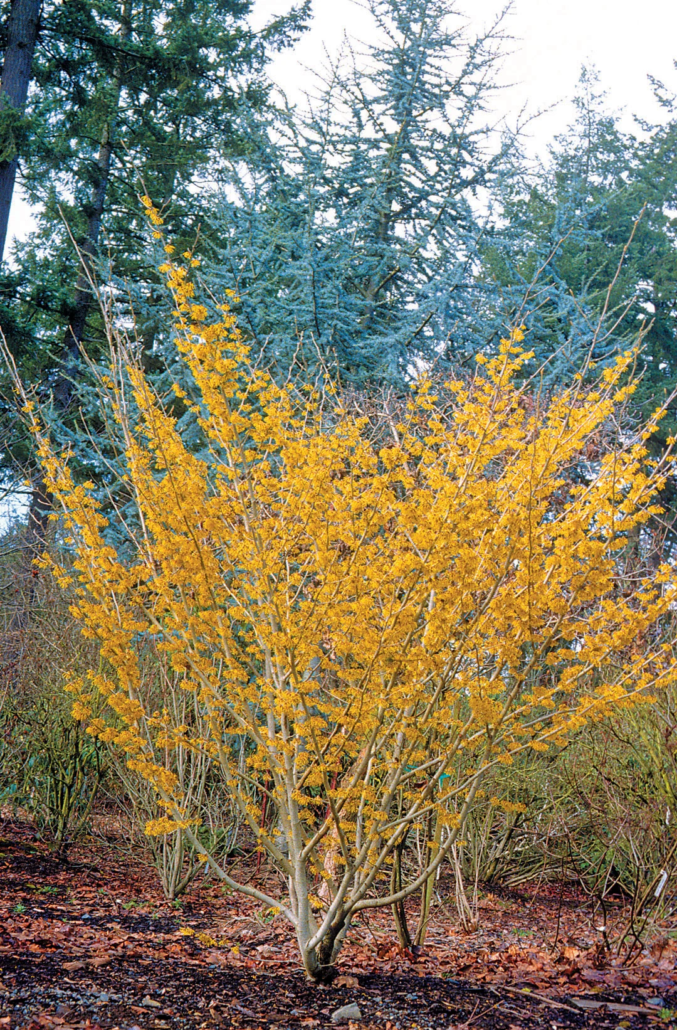
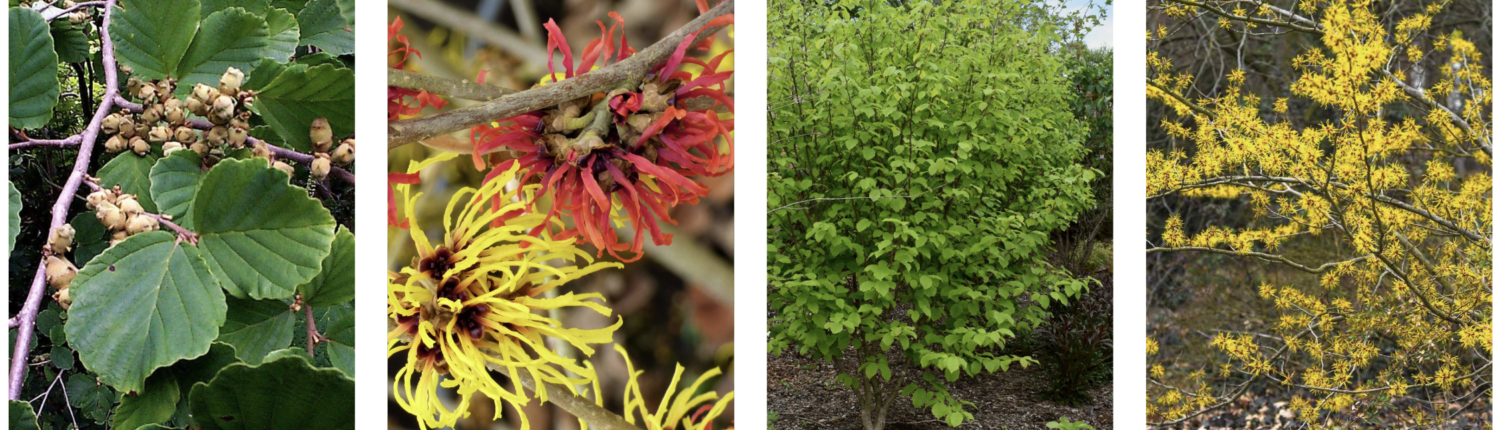
This native, deciduous shrub has a rounded crown with a graceful, vase shaped growth habit and yellow, fragrant flowers that emerge September to October along with yellow fall leaf colour. The flowers are ‘stem hugging’ clusters with four ‘crinkly, strappy, ribbon shaped petals’ that usually emerge while the leaves are still on the tree.
The Common Witch Hazel grows in eastern North America including eastern and southern Ontario and can be found in woodlands, and along forest margins and stream banks. In the garden it can be used as a shrub, hedge, or as in my case, pruned into a small, multi-stemmed specimen ‘tree’, which suits my small suburban garden. Growing 15-20 feet high and wide, in full sun to part shade it grows well in average, medium moisture well drained soil. It is a low maintenance shrub with no serious insect or disease problems and requires only minimal pruning done in spring. (As with any woody plant pruning out dead, damaged or diseased wood should be done when discovered.) Among its many charms this native shrub has a beautiful winter silhouette, attractive grey bark, attracts birds and is considered tolerant of road salt, deer, erosion and clay soil. According to the Morton Arboretum, Common Witch Hazels also serve as a host plant for the larvae of the spring azure butterfly. What’s not to love!
Hamamelis virginiana has an interesting reproductive process. The flowers are wind or insect pollinated but after pollination fertilization of the ovules is delayed until the following spring with the fruit developing during that growing season. The fruits are greenish seed capsules that become woody by fall. These woody seed capsules then split open ‘exploding’ its one to two black seeds up to 30 feet away. According to the Brooklyn Botanical Garden fruit set is very low.
| Common witch-hazel Facts and Features | |
| Size range | Large shrub (more than 2 meters), Compact tree (3-5 meters), Small tree (5-8meters) |
| Sun/Shade | Full sun (6 hrs direct light daily), Partial sun / shade (4-6 hrs light daily), Full shade (4 hrs or less of light daily) |
| Soil | Moist, well-drained soil |
| Flowers | Fragrant, Yellow |
| Shape/form | Irregular, Round, Upright |
| Crucial Pollinator Source | As one of the last plants to bloom (Oct-Nov), its fragrant yellow flowers provide nectar and pollen for bees and flies. |
| Wildlife Habitat | The shrub's thicket-forming nature provides excellent cover, nesting, and shelter for birds. |